|
|
 |
A meditation (or a Luddite rant, depending on your point of view):
(and why no reproduction is the same as an original)
(and why the semiconductor industry is important)
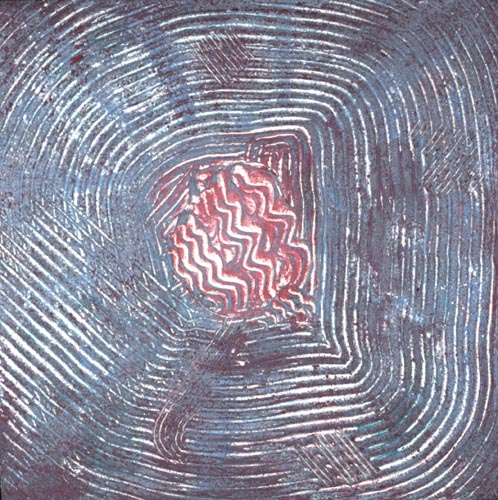
These two images illustrate technology which became available
to JulieArt in the first half of 2000. The "old" image was on the
website until August 2000. The new image (right) is from a 35 mm
slide on Kodak EPY tungsten film scanned with a Minolta Dimage F2900
Scan Elite and post-scan balanced slightly in Photoshop 4.0. The full
scan is roughly 2100 pixels square (2820 pixels per inch or ppi)
which will produce a decently detailed print. The old image was
scanned from a 4x6 inch color print / Kodak 35 mm consumer film,
probably exposed with "daylight" mercury vapor arc lamps. We have a
couple of these lights in the studio, so I tried to use them. This
light produces a strong greenish cast on daylight balanced film. The
light requires color correction filters in front of the camera lens
(20R+20M) and considerable color manipulation in Photoshop. I thought
the results were pretty good a year ago. While this light source may
look "daylight white" it is really the output of only a few fairly
narrow band phosphors. The real problem though, I think, is that it
does not bring out all of the colors well because it is so "peaky"
across the color spectrum. The 3200K tungsten illumination I now use,
in contrast, is at least a continuous spectrum. The new image is a
considerably better representation of the original artwork. The color
balance lesson here is that you can't get good results from a
compromised original. Now if I could figure out how to convey the
relief on the painting's surface. . . .
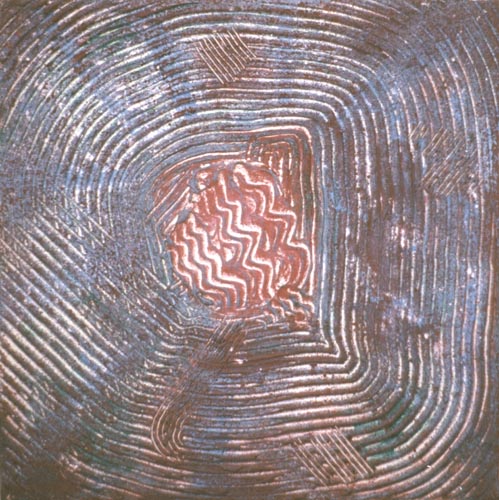
The difference in sharpness is even evident in the 500 pixel square level 4 JPEGs seen here. One lesson I have learned is that a scan from the original film preserves more detail and gives one better color control. Escaping the tyranny of the automated photo processing machine, whose designers apparently constructed its algorithms on the principle that all photos should be balanced like snapshots of scenery or people, is not easy. Why don't I use a digital camera? I need 35 mm slides anyway and a good digital camera that will equal the results I can get from film and the film scanner is pretty pricey. And then I would have to use a film recorder to get the slides. No thanks, I'll do it this way for now.
Its really limiting to look at a 24 inch square painting reduced to 250,000 pixels in the images above. The JPEG compression / expansion process regenerates these pixels pretty well, at least in this case. I have trouble seeing any difference at all between the original scan and a JPEG level 4 or 5 image. The original painting, up close and personal, probably contains the equivalent of God-knows-how-many billion pixels (think 3D as well). The full 2820 ppi scan from 35 mm film is better than the above, at almost 5 million pixels, but its not exactly virtual reality either. For one thing, the 2820 ppi scan is definitely limited by the sharpness of this (or almost any) 35 mm slide, its more than required by at least a factor of two. However, you need more resolution in the scanner than the film will produce. You must "oversample" to not miss anything and you do not want to see individual pixels at any practical level of magnification.
If you have the bandwidth and/or patience to download a 420K file, this is a 1500 pixel square version of the new image, which gives you a much better feel for the painting and for what the web will be like when the pipes are all bigger. Remember, this image at 200 ppi, a very respectable level of resolution for a nominal 720 dpi inkjet printout, is still only 7.5 inches square. If you think this is a big download, remember that, as a bitmap with 8 bits in each color channel, the 2100 pixel square original scan is a 13 megabyte file. Thanks, JPEG. Feel free, print it out, look at it, think about it, just don't sell it.
Now, if you wanted to take a really good color photograph of a painting you would use 8 by 10 inch sheet film. Say you wanted to publish one of those coffee-table art books or a full-size reproduction, you would probably go to those lengths. With a resolution on the order of a couple thousand ppi, you could see dust on the surface of the painting or measure individual glitter particles (horrors, glitter in "fine art?"), if there were any. You would be able to measure the glitter, that is, if the film had the dynamic range to capture the intense reflection from its surface, which it doesn't. A little mirror-finished particle reflecting a large part of the incident light is so bright, so much, much brighter than "white," that it just overloads the film. That's why any "active" glitter on paintings on this website tends to show up in the images as big, bright washed-out blobs. The amount of glitter that you can see at any moment is a small fraction of what is on the artwork, which is why the original work sparkles or looks iridescent as you move past it. Its why the works can change their character completely from day to night.
Say its stupid, say it isn't really fine art, say it looks about as interesting as wallpaper if you feel a little nasty, but its one reason I continue to enjoy living surrounded by many of these works year after year. I'm always seeing something new in them. The best ones continue to hold my interest over time. You cannot really reproduce these artworks or the experience of being with the artworks through ANY technology we are likely to have for quite a while, if ever. The abstract works don't look like anything or mean anything explicit, they don't have any purpose except to engage you. They are just out there like the sky, out there whispering to your neurons in their own private language. Suit yourself, but it adds up to "fine art" in my book.
So how many gigabytes do you need to reproduce the experience of standing in front of the painting? Lots more than we have available.
That's why you really have to see the real thing. It makes you appreciate the "processing power" of your eyes and brain.
If you have ever wondered why we "need" all those new semiconductor chips, all those terabytes of memory and gigaflops of CPU somewhere in the near future, you should now have a small clue. Its never going to be "just like being there," high-resolution 3D virtual reality, but its going to be something you will come to believe you need in your life. As I write this, the semiconductor industry has yet to build its first full-production 300 mm wafer fab. The bigger the wafer, at least so far, the cheaper the chips get and the more affordable the new gadgets become. We're talking about putting patterns with 0.1 micron features all over thin 12 inch diameter plates of single-crystal silicon here, so the problem is not trivial. Billions of transistors, and virtually all of them must be functional. I worked in the industry for nearly 20 years and I think its just a little bit better off for my having spent the time. The semiconductor industry consulting I still do contributes to solving a few of the myriad remaining problems in a finite but usually infinitesimally small way. Semiconductors, fine art, images, resolution, minute details, the microscopic and quirky texture of the real and imaginary worlds. . . .
David