Technical Direction
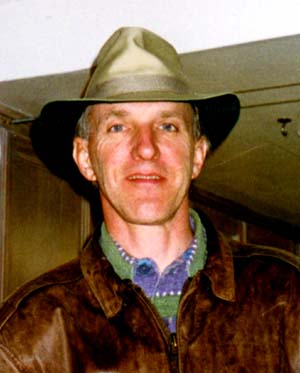
Technical Direction
"We" includes David Sheriff, JulieArt's Technical Director, Carpenter,
Plasterer, Computer Graphics demi-Wizard, Janitor, Co-Artist,
Semiconductor Industry Consultant, Business Manager, Author, Marketing Guru,
Bus Driver, Training Seminar Leader and Webmaster.

This is pretty much a self-contained, build-it-up-from-scratch operation.
The picture frames, for instance, start out as a big hunk of hardwood that gets
cut up and milled into moulding before being trimmed to size and glued into
something that will form a decent transition between the art and the environment.
Oh, that doesn't count scraping, sanding, staining and finishing.

Now I understand why picture framing is expensive.  It has also been
a good object-lesson in the principle that the more you learn, the more you
realize how little you know.

This is supposed to be semi-retirement.  It qualifies in that I no longer dive into a sea
of 14 hour days Monday morning and hope I can hold my breath until Friday or whenever
the week actually ends, if it does.  I get more exercise, I eat better, I see more of my
wife, children and grandchildren.  I try very hard to avoid doing anything boring or not much fun.
But there are still just as many minutes in the day, its just harder to decide how to spend them
when THE JOB isn't running your life.  Don't get me wrong, I loved my "career."
I amassed as much power and influence as I ever wanted.  You can never be
too rich, as the saying goes, but life isn't just about money.  Answer this question,
if you have doubts: How much do you need before you stop?  Do you keep going into the
office and getting on those airplanes because you really don't have anything you would
rather do?  If so, ok.  If not, and you have the nerve, freedom is more fun.

email:  david@julieart.com
If you would like to be on an email list to be notified when there are substantial upgrades to the site, drop me a line. Or not.
Participating
in the Search
JulieArt's spare CPU cycles are at the disposal of the SETI@home project. As of 15 August 2000, we processed exactly 224 Data Units. Each Data Unit is a very, very small chunk, an almost infinitesimal smidgen, of the output of the large radio telescope in Aricebo, Puerto Rico. The data is analyzed in an attempt to detect certain patterns of activity which would distinguish something in the signals that is not just the random noise of the Universe. This has consumed 3400 hours, 52 minutes and 52.7 seconds of CPU time in the JulieArt workstation. (Ah! that such a completely meaningless number is known to such incredible accuracy.)
It is cool to be part of the largest computer project ever conducted. 1,745,812 users, some running multiple computers, are participating in the project as of mid-July 2000. Last fall, the group passed 100,000 YEARS of CPU time devoted to the project. The group, working together on the same problem, constitutes by far the most powerful supercomputer on planet Earth. JulieArt is in the top 10% of all users in the amount of work that we have completed for the project.
Why? The highly unlikely discovery of another intelligent life form in the universe could have a dramatic, probably positive effect on humanity. So why not? We rarely use the full power of the computer but it runs all the time, so why not do something with the "unused" computer capacity? The only other thing that makes sense is to use the computer as a really screaming Prayer Wheel in its spare time. Just think, a brief prayer repeated mechanically millions of times each second. Somehow, SETI@home does not seem all that different, or any less likely to produce extraordinary results.